

Newsletter May 2024
You will find below the new issue of our Newsletter (May 2024).
Since the beginning of April 2024, substantial modifications have been made to Greece’s Golden Visa Scheme, and those seeking to work remotely in Greece.
When it comes down to Greece’s Golden Visa Programme, an established residency-by-investment scheme, the main benefits are:
- The Right To Live in Greece
- The Visa-Free Travel With Greece Residence Permit
- Family Reunification
- Low Investment Threshold in a Promising Real Estate Market
- The Double Taxation Treaty
In particular, the new law 5100/2024 (Government Gazette A’ 49/05-04-2024) focuses on the reduction of the housing market challenges and the attraction of more foreign investments that prioritize sustainable development.
The primary modifications to the Golden Visa scheme concern the valuation of real estate holdings. The new rule introduces the minimum dwelling area of 120 square metres requirement.
It further sets a minimum acquisition value per region per popularity. It is needless to state that the below breakdown has also a limit to ending up investing or co-investing on a sole property in the region (for individuals:
- Tier 1: The minimum real estate acquisition cost for popular areas such as Attica, Thessaloniki, Mykonos, Santorini, or other islands with more than 3,100 denizens has been raised to €800,000 per individual investor or per co-investor,
- Tier 2: The next investment requirement drops down to €400,000 per individual investor or co-investor. This threshold has been established for properties in Greece’s larger areas, extending investment options beyond the top locales.
- Tier 3: Special categories, such as properties being converted from commercial to residential usage or (full or partly) historic structures in need of renovation, have a €250,000 barrier. This also applies to industrial buildings. Especially for those special categories it is worth mentioning that any transmission of use needs to be finalized before the permanent Golden visa application.
For example, an individual eager to invest in properties in high-demand areas such as Attica, Thessaloniki, Mykonos, Santorini, or other islands with more than 3,100 denizens, will have to focus his or her search for a sole property of 120 Sq. m, with an acquisition value of EUR 800,000 or more. In the case of a co-ownership, this minimum acquisition value in those areas is EUR 800,000 per individual co-owner. As regards another region, this limit drops down by half, at EUR 400,000 acquisition value per person. If, however, an individual investor or co-investors is/are looking for an Athens-based property with the intention of changing its use from commercial to residential, or, if that property is characterized as preserved/historic, then the budget for that acquisition cost may be eligible to drop to a EUR 250,000.
The same breakdown applies to long-term complex leases for touristic purposes. Considering the regulations and Adherence to Guidelines, Golden Visa applicants need to be cautious with the lease agreement duration and avoid change of business use. For instance, the address of a rental contract should not be used as a registered office or a branch of a company, as it might affect the Golden Visa Application and bring fines. The same danger comes for the Short-Term Residential Rental. Other cases to be attentive to are:
The Short-Term Rental Limitations:
- Golden Visa-owned properties are not allowed to be used for short-term rentals, such as Airbnb. This measure is intended to avoid the adverse effects that these rentals can cause on local housing markets.
- Golden Visa properties are not allowed to be used for commercial purposes, meaning they must be used primarily for residential purposes and cannot be used as business offices, after the change of use.
- Residence permits that can be renewed are renewable for five years as long as the investment is maintained.
To continue enjoying the advantages of the former Golden Visa system, non-EU citizens can finalize their investment by 31 December 2024, as long as they pay a 10% deposit of the property’s purchase price or total rent specified in the contract (for tourist accommodations with complex and time-sharing leases).
As for the new applicants, and with respect to law 5100/2024, the investors must go through the application process and choose the appropriate property bearing in mind the above criteria, prepare all the required legal paperwork and request for the Golden Visa residency permit.
The Golden Visa Scheme also includes choices for investments outside the real estate scope, like investing in Greek companies, buying government bonds, or putting money into mutual funds, each with different minimum amounts required.
As a suggestion, investors aiming to secure Golden Visas should assess the requirements and eligibility criteria based on the most recent regulations.
Furthermore, Greece has created two distinct immigration options for digital nomads as outlined in Article 68 of the latest immigration legislation, Law 5038/2023.
- That is for Individuals who fulfil the criteria and are able to apply for a Digital Nomad Visa (type Z.1) at the Greek Consulate in their place of residence, travel to Greece, and subsequently submit an application for a two-year residency permit which is renewable. The main applicant has the choice to bring a family member(s).
- Those who fulfil the conditions can visit Greece either with a temporary visa or their passport (if visa exemption applies) and subsequently request a two-year residence permit in Greece (referred to as the “Financial Independence Residence Permit”) for individuals with sufficient financial resources. In this case, individuals are required to present a valid lease agreement or a property purchase contract in their name in Greece. Family members can also escort the digital nomad.

© tilergasia – shutterstock.com
As a result, Greece become particularly interesting for digital nomads. Our motion is for employers to consider a review of their internal policies and keep their employees informed about the most recent changes in Greek immigration regulations.
Since the end of 2023, Greece’s Ministry of Labour and Social Security has introduced the Digital Employment Card System, establishing fresh salary boundaries for executive categorization, and revising the guidelines for online submission of Labour Inspectorate and DYPA forms to the ERGANI II system. Businesses that are mainly in the industrial and retail industries will be part of the system, but those in the energy, petroleum products, and mining industries will not be included. Penalties can be enforced for failure to comply with the Digital Employment Card, which has been in force gradually since the first days of 2024.
As of March 1st, Executive employees are required to report their staff details to the ERGANI II online platform by submitting the “Basic Terms of Employment” form with any necessary changes. This involves adding “individuals allowed to make decisions independently” (in Category A), lowering the monthly pay for executive staff to four times the minimum legal salary (Category B), and decreasing the pay requirement to six times the minimum legal salary (Category C).
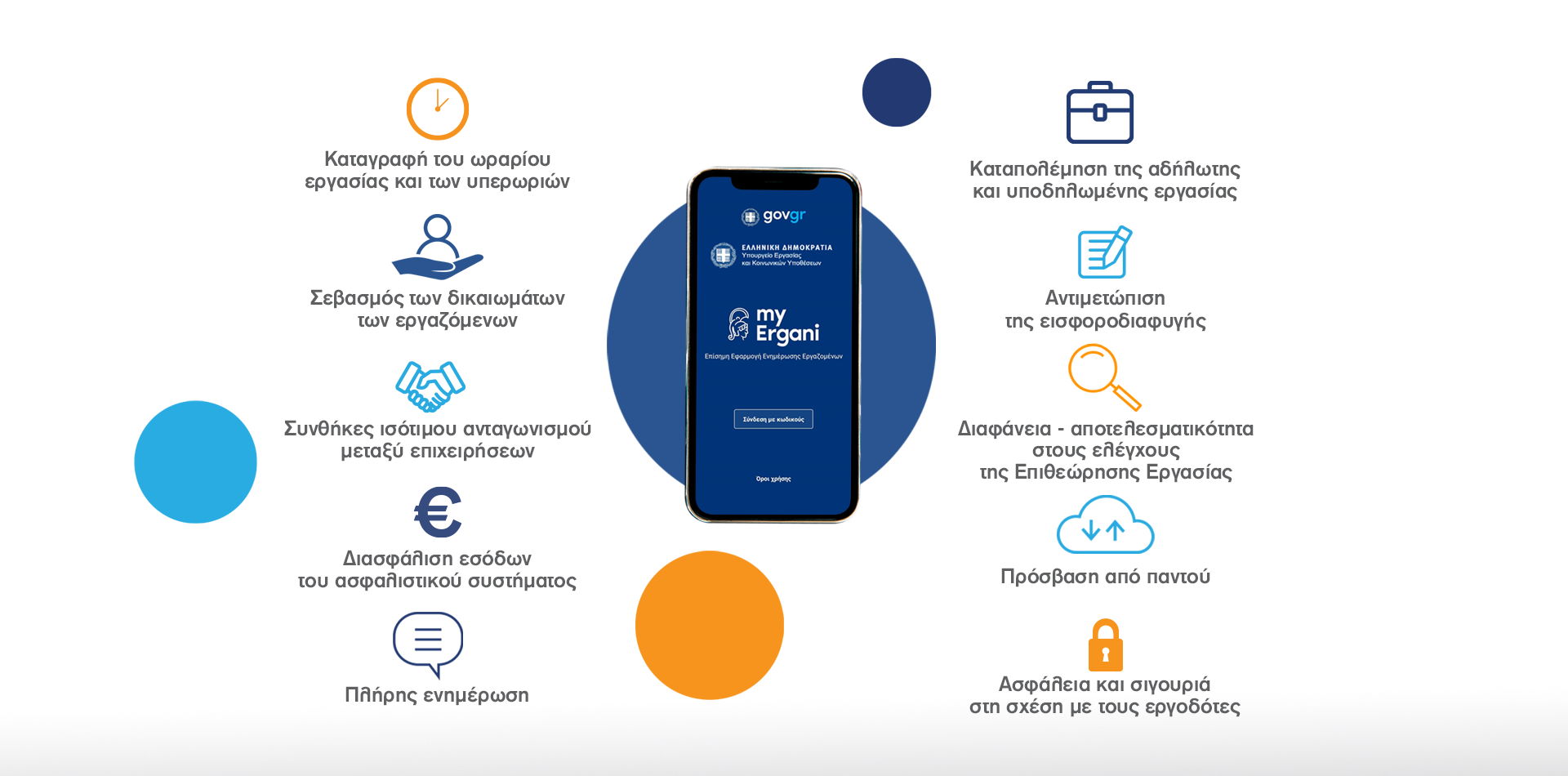
© Digital Employment Card – https://psifiakikarta.gov.gr/
The ERGANI II online system updates the guidelines for electronically submitted declarations, such as Basic Terms of Employment declarations, uploading of employment contracts, termination notifications, collective labor agreements, annual leave notifications, zero-hours employment contracts, construction, and technical works declarations, and reporting declarations.
On April 10, 2024, Greece passed law 5100/2024 to implement Pillar Two rules, transposing EU Directive 2022/2523 for a global minimum taxation level on multinational and large domestic groups. Effective from January 1, 2024, the rules apply a top-up tax when profits are deemed low-taxed below a 15% effective tax rate. Three mechanisms are in place to collect the tax, including a Qualified Domestic Minimum Top-Up Tax.
The Greek tax basis and Pillar Two tax basis differ in their income inclusion rule, undertaxed profits rule, and safe harbor provisions. The Greek Income Inclusion Rule requires UPEs in Greece to pay top-up tax for entities in low-tax jurisdictions. The Undertaxed Profits Rule collects residual top-up tax and allocates it based on certain criteria. Safe harbors provide relief during the initial Pillar Two rule application.

© Miha Creative – Shutterstock
For UPE jurisdictions with a corporate tax rate of at least 20%, the calculated amount will be considered zero. The QDMTT safe harbor exempts groups from applying the IIR for jurisdictions with QDMTT, subject to local rules. In Greece, in-scope entities must file a top-up tax information return and Greek tax returns within specified timeframes.
Contact us:
ECOVIS HELLAS LTD.
10 Solonos str.
106 73 Kolonaki, Athens
Phone: +30 210 3645471 /
+30 210 3842325